

Extraversion – Conscientiousness – Personality traits
 A study published in the journal Psychoneuroendocrinology demonstrates that leukocyte gene expression correlates with two major dimensions of human personality, extraversion and conscientiousness.
Personality is commonly defined as a cluster of individual psychological attributes, which are typically stable across time and situations and give rise to enduring individual differences.
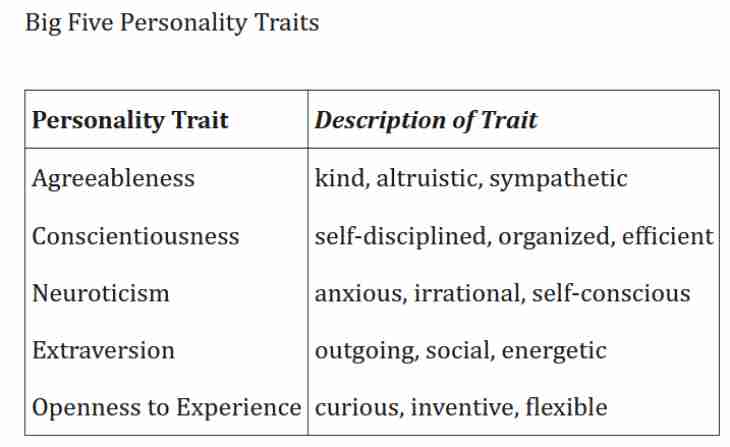
Multivariate analyses have generally identified 5 major dimensions of human personality – Neuroticism, marked by a tendency toward negative affect; Extraversion characterized by high levels of sociability and appetitive motivation; Openness to Experience, which reflects general curiosity, creativity, and an orientation toward intellectual and aesthetic pursuits; Agreeableness, reflecting general likability and even temperament; and Conscientiousness, reflecting planfulness, caution, and harm avoidance.
A recent study in nonhuman primates provides new insights into the neuroanatomical basis of personality, showing that personality traits are linked to the anatomy of specific brain structures such as the anterior cingulate cortex and the brain prefrontal cortex.
The temporal and situational stability of personality has led generations of researchers to hypothesise that personality may have enduring effects on health. And some large epidemiological studies have found associations between personality characteristics and measures of disease or longevity.
Several causal models have been invoked to explain associations between personality and health, including common causation by underlying individual differences in genetics or early life experience; effects of personality on health behaviour, etc.
One body of theoretical analysis suggests that individual differences in the vigour of biological immune responses may come to be associated with individual differences in personality traits that serve as a sort of ‘behavioural immune response’. According to this theoretical approach, individuals who have relatively weak biological immune responses are hypothesized to show stronger behavioural immune responses such as avoidance of strangers (i.e., Introversion), reduced exploratory behaviour (i.e., low Openness to experience), and greater harm-avoidant behaviour (i.e., Conscientiousness).
Conversely, allostatic physiology suggests that biological immune defences may be up-regulated in individuals who experience extended exposure to threat or stress and might thus experience an elevated risk of injury or infection, or in highly sociable individuals who face increased exposure to communicable diseases.
Research in the neuroscience of personality has also provided connections between dopaminergic neurotransmission, and the reward-processing functions of the dopamine system and various aspects of personality and individual differences.
For centuries, personality traits have been linked to health status and outcome. New research indicates that the frontal cortex of the brain and asymmetries in this region may constitute the neurobiological foundation of broad personality traits.
In the Psychoneuroendocrinology study the research teams from the University of Nottingham, UK; the Washington University, St. Louis, and the University of California, Los Angeles, USA utilized a functional genomics approach to identify relationships between the 5 major dimensions of human individual differences in personality and broad patterns of gene expression in human leukocytes.
The authors dentified systematic differences in leukocyte gene expression that correlate with individual differences on two major dimensions of human personality: Extraversion and Conscientiousness.
Consistent with predictions from behavioural immune response theory the investigators provide evidence that extraversion is associated with up-regulated expression of pro-inflammatory genes, whereas conscientiousness is associated with down-regulated expression of pro-inflammatory genes.
The pattern of associations between leukocyte CTRA gene expression and specific dimensions of human personality are largely as would be predicted by the behavioural immune response hypothesis i.e., that stable individual differences in behaviour arise in response to stable individual differences in biological vulnerability to infection.
Interestingly, as personality may be associated with inflammation, recent research also indicates that personality traits such as conscientiousness and neuroticism are associated with levels of the pro-inflammatory cytokine interleukin (IL)-6 [A.R. Sutin et al., 2010; N.A. Turiano et al., 2013].
Despite the fact that causality and the biological mechanisms behind these associations remain poorly understood, further research along these lines may provide new insights into the well-known epidemiological associations between personality and physical health.
Source: Psychoneuroendocrinology
Read More: www.nottingham.ac.uk
Updates
A 2019 study by En-Young N. Wagner et al., published in Frontiers in Psychology reported that higher extraversion was positively associated with higher IL-6 levels, and higher conscientiousness were significantly associated with lower IL-6 levels. Neuroticism and agreeableness showed no significant association with any inflammatory biomarker.
In this Swiss community sample of 2,182 adult individuals, the main finding was that
extraversion, openness, and conscientiousness seemed to be significantly associated with IL-6 levels.
Of note, the association between personality traits and inflammation was maintained after adjustment for mental disorders.
Importantly, these findings suggested that
personality traits may have a link to chronic low-grade inflammation,
which is a known risk factor for various health issues.
The authors concluded that their study has suggested
independent modest associations between high extraversion and low conscientiousness with high IL-6.
Thus, previous studies showing poor health outcomes to be linked to particular personality traits could partially be explained by inflammatory activity.
Low-grade inflammation might contribute to vascular pathologies, mainly atherothrombotic cardiovascular diseases, but also other adverse health outcomes over time. However, this hypothesis and their clinical relevance in the community need to be confirmed in longitudinal studies.
A 2022 study by Summer Mengelkoch et al., published in Personality and Individual Differences provided insights into potential mechanistic drivers of the link between personality and immune function and the possibility that, in some cases, relationships between personality and immune function may be sex differentiated.
 Thus, for example, the study found that high TNF-α producers were more extraverted than low-producers and that men who were high IL-6 producers were less extraverted than low-producers. Or, that higher extraversion was related to greater LPS-induced proinflammatory cytokine release by PBMCs in vitro, while higher conscientiousness was associated with lower levels of plasma IL-6.
Interestingly, and, consistent with previous research, the results of this study also suggested those high in conscientiousness had decreased markers of inflammatory activity, and
those high in extraversion had increased markers of inflammatory activity.
Results also revealed that higher levels of extraversion were associated with lower numbers of eosinophils and basophils (the latter in women only), potentially suggesting a skew toward Th1 over Th2 immunity in individuals high on this trait. This possibility is further supported by the finding that men high in extraversion had higher counts of monocytes than did men low in extraversion.
Background: Th1 immunity is primarily involved in the body’s response to intracellular pathogens, like viruses, while Th2-biased responses are typically observed during macro parasite infection, such as with helminths, and also play a role in allergies. Interestingly, due to growing population density and urbanization, most modern human populations are exposed to much higher numbers of viruses than parasitic worms (Amoroso & Nunn, 2021).
Accordingly, the heightened sociality associated with high extraversion likely increases one’s exposure to viruses, specifically, which may lead to a Th1 skew. Additionally, high levels of extraversion, and for women, high levels of agreeableness, were found to predict increased S. aureus growth in plasma in vitro.
The authors discussed that across different studies, conscientiousness and extraversion appear to be reliably related to levels of inflammation (although the directions of these relationships sometimes differ), while agreeableness is not.
Importantly, the authors also underscored that
the consistent relationships observed between inflammation and extraversion,
both in their work and in the work of others, further underscore that individual differences in human tendencies for behavior may be shaped by one’s immunological vulnerabilities.
Furthermore, based on the results of this study, in which extraversion was associated with being a high-producer of TNF-α, the authors suggested that differences in extraversion may be borne out of different immunological profiles, rather than the differences in levels of inflammation being exclusively the result of greater contact with others.
The authors concluded that despite limitations, their study provided important data bearing on relationships between personality and immune function.
Related stories you may like:
Perfectionism: A Disease Risk Factor Just as Obesity and Smoking?
Interleukin-6 – a Better Predictor of Future Cardiovascular Events Than C-Reactive Protein?
Optimism Linked To Better Cardiovascular Health
The Link Between Stress, Emotions and Cytokine-Related Diseases
Coronary Artery Disease and the link to Stress and Immunity
Neuroendocrine Phenotypes that Affect Immune Responses in Mammals Found in Avian Species