
Lena Johansson – stress and Alzheimer’s risk
 In a recent editorial, Lena Johansson outlines some current concepts and research trends related to the long terms effects of stress and their impact on risk and development of Alzheimer’s disease (AD) in women. Dr. Johansson has authored two population studies – perhaps the first in this area – on the role of midlife stressors and increased risk of dementia in late life.
What drives the stress and AD association is not entirely clear, but the author highlights two possible mechanisms.
The first mechanism discussed is related to glucocorticoids effects on brain and the ‘glucocorticoid cascade hypothesis’, introduced by Robert M. Sapolsky et al., in 1986 and based on two premises: first, that senescence is a form of decreased adaptiveness to stress, and, second, that chronic stress can accelerate the aging process.
Per data from experimental aged animals, it appears that in the aged organism, secretion of adrenocortical glucocorticoids persists even after the stress has ended. Degenerative changes in the region of the brain that normally inhibits glucocorticoid release may be caused by cumulative exposure to glucocorticoids, which in turn switch on feed-forward cascades leading to even higher cortisol secretion from the adrenal gland with further neuronal loss.
According to the ‘glucocorticoid cascade hypothesis’, high and longstanding levels of cortisol lead to shrink and loss of neurons, especially in some vulnerable areas in the medial temporal lobe because of the high amount of cortisol receptors. Loss of neurons in these areas can lead to inhibitory feedbacks to the HPA axis, which in turn result in even higher cortisol secretion from the adrenal gland with further neuronal loss. Several studies have found associations between severe stress and atrophy in brain, for example, in the hippocampus complex.
Interestingly, a number of studies have reported associations between stress-prone personality, that is, high neuroticism and development of AD. Personality is defined as characteristics stable over time, which influence an individual’s thinking and emotions, and the personality trait neuroticism refers to stress proneness, emotional instability and negative affectivity. The Baltimore Longitudinal Study of Aging assessed personality in a large sample of middle-aged men and women. During the 22 years of follow-up, it was found that high neuroticism was associated with increased risk of developing late-life AD.
The second mechanism is related to the association between chronic stress and hypertension, metabolic syndrome and a dysfunctional immune system, which in turn have been associated with dementia and AD.
Women specifically are more prone to stress-related disorders and have greater associated morbidity; they also react to stress with greater cortisol response, limbic system activation and cytokine activity as compared with men.
In addition, hypothalamic-pituitary-adrenal (HPA) axis responsiveness is greater in women than in men, mostly due to estrogen’s ability to induce corticotropin-releasing hormone gene expression and noradrenergic function (GP. Chrousos, DJ. Torpy and PW. Gold, MD; Ann Intern Med. 1998; 129:229-240).
Recent epidemiological studies have linked stress and AD compellingly. Via the Prospective Population Study of Women, a longitudinal cohort study from Sweden spanning over 30 years, Dr. Johansson and colleagues have shown that long-standing stress in midlife is associated with AD, temporal lobe atrophy and white matter lesions later on, and that experiencing a greater number of psychosocial life stressors is associated with higher incidence of AD.
Also linked to AD in other studies are: parental death during childhood, chronic work-related stress, post-traumatic stress disorder, high neuroticism and anxiety.
The association of stress and AD, while supported by recent evidence, is difficult to delineate well due to the paucity of longitudinal studies. The consequences of chronic stress are a particularly pertinent topic as the average life span increases and our overall population ages. In addition, it is important to recognize the existing gender disparities, in AD as in other illnesses, so as to better understand the neurohormonal processes involved therein.
In conclusion, the author discusses that despite evidence that longstanding stress has damaging effects on brain, little is known about stress as a risk factor for AD. Thus, importantly, longitudinal studies are lacking. It has been suggested that structural AD changes in brain appear already 20–30 years before the disease get clinically manifested, and the pathological levels of β-amyloids have been found to be fully altered 10 years before conversion to AD.
Source: Expert Rev Neurother, 2014, 14:123-5. doi: 10.1586/14737175.2014.878651.
Read more: Expert Rev Neurother
Updates
2019
A 2019 study by Cynthia Munro et al. analyzed the data on more than 900 Baltimore adults, and multivariable models were used to examine the association between traumatic and stressful life events at Wave 3 (1993–1996) and cognitive change by Wave 4 (2004–2005). The authors found that a greater number of stressful life events at Wave 3, but not of more remote stressful events, was associated with greater verbal memory decline by Wave 4 in women but not in men.
The Johns Hopkins Medicine researchers concluded that unlike men, middle-aged women with a greater number of recent stressful life events demonstrated memory decline over a decade later. Thus, sex differences in cognitive vulnerability to stressful life events may underlie women’s increased risk of memory impairment in late life.
Interestingly, according to Johns Hopkins University news report the first author of this study Cynthia Munro, Ph.D. said that prior research by other investigators showed that the effect of age on the stress response is three times greater in women than in men. Moreover, other research has shown that stressful life experiences can result in temporary memory and cognitive problems.
2023a
A 2023 study by Johanna Wallensten et al. investigated whether chronic stress and depression are associated with a higher risk for mild cognitive impairment (MCI) or dementia, including Alzheimer disease (AD), and whether any such risk is additive.
The authors concluded that their study suggested an increased risk for MCI and AD if a patient with depression is additionally exposed to chronic stress as indicated by the diagnosis chronic stress-induced exhaustion disorder (SED). Of note, the Swedish medical system includes a novel diagnosis, i.e. chronic stress-induced exhaustion disorder (SED) that can be used as a proxy for longer-term non-trauma stress.
The investigators reported that both preceding depression and SED were independently associated with increased risk for MCI and AD, but only depression was associated with increased risk for other dementia i.e., Lewy body, vascular and mixed dementia. According to the authors, the marked additional effect of chronic stress in patients with depression for developing MCI or dementia has not previously been presented in an epidemiological cohort study.
The investigators also discussed that their results are in line with previous findings that patients with depression and patients exposed to stress seem to have an increased risk for MCI and dementia.
2023b
Another 2023 study by Hannah M Edwards et al. used in vivo microdialysis to measure levels of Aβ in response to acute stress in male and female mice. The authors reported that Aβ levels are altered differently between female and male mice (APP/PS1 and wild-type) in response to stress, with females showing significantly increased levels of Aβ while most males do not show a significant change.
Thus, the study demonstrated that Aβ levels are altered differently between female and male mice in response to acute stress. In both APP transgenic and WT female mice there was a robust and prolonged increase in ISF Aβ during stress that persisted long after the stressful event, while most males did not show a change in ISF Aβ at all.
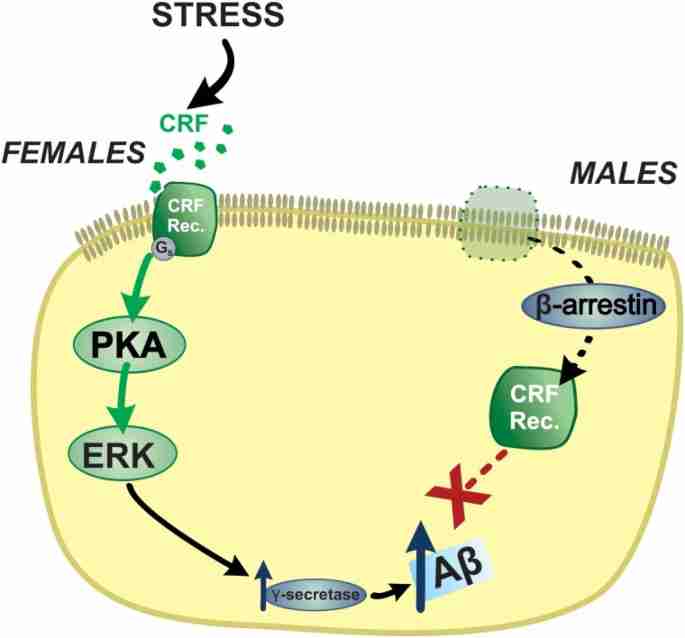 Stress-induced signaling pathways. Left: In females, during stress CRF acts within the hippocampus to activate CRF-R, PKA and ERK, probably through its Gs-coupled pathways, to increase Aβ levels. Right: In males, however, during stress β-arrestin internalizes the CRF-R to reduce signaling, thereby preventing the stress-induced change in Aβ. From: Sex-dependent effects of acute stress on amyloid-β in male and female mice, by Hannah M Edwards et al. Brain. 2023 May 2;146(6):2268–2274. doi: 10.1093/brain/awad052
Of note, local administration of Corticotrophin Releasing Factor (CRF) antagonist, PKA and ERK inhibitors eliminated the Aβ stress response in female mice confirming dependence on local signaling of CRF within the hippocampus. The authors discussed that a similar stress related plasma corticosterone response between male and female mice indicated a similar CRF release between sexes in response to acute stress.
Therefore, according to them, the different response of male mice relative to female mice could occur at the level of the CRF receptor. They also discussed that the CRF receptor signals differently between the sexes during stress; females activate a PKA/ERK pathway, whereas in males β-arrestin removes the receptor from the cell surface to limit signaling. The authors concluded that the basis for this sexual dimorphism in the CRF-R signaling pathway between the sexes is unknown.
2025
A 2025 study by A. Salardini et al. used a retrospective review of longitudinal data from the Framingham Heart Study (FHS) participants to examine the association between serum cortisol levels measured in middle age and amyloid/tau PET imaging outcomes approximately 15 years later in a well‐characterized cohort.
Particularly, the investigators analyzed data from 305 cognitively unimpaired FHS participants. Serum cortisol was categorized into tertiles, with amyloid ([11C]PiB) and tau ([18F]Flortaucipir) positron emission tomography (PET) imaging conducted 15 years later.
The authors of this study reported a significant association between elevated serum cortisol in early midlife and increased amyloid deposition 15 years later, measured by PET imaging. This association was specific to post‐menopausal women and was absent in men or in relation to tau deposition in either sex.
Of note, this study found a difference in amyloid accumulation chiefly in the posterior cingulate and precuneus. The precuneus and posterior cingulate cortex emerge as primary sites of early amyloid deposition across multiple independent cohorts, including Alzheimer’s Disease Neuroimaging Initiative (ADNI) and BioFINDER.
According to a University of Texas Health Science Center at San Antonio’s News report: “The results highlight the importance of identifying early risk factors when biomarkers are detectable but cognitive impairment is absent,” said Arash Salardini, MD, associate professor of cognitive and behavioral neurology with the Glenn Biggs Institute for Alzheimer’s and Neurodegenerative Diseases at UT Health San Antonio. Salardini is first author of this study.
Below is a summary of the key findings and mechanism(s) of this study, as presented by the Google’s AI Overview:
Key Connections Between Stress and Alzheimer’s Risk
Biological Mechanism: High stress elevates cortisol, which is linked to increased deposition of amyloid-beta, a protein that forms plaque in the brains of Alzheimer’s patients.
Midlife Vulnerability: Women experiencing high emotional stress, anxiety, or stress-related exhaustion during middle age are more than twice as likely to develop dementia later in life.
Gender Differences: Studies suggest that stress has a more severe effect on females’ brains compared to males, causing sharper increases in Alzheimer’s-related proteins.
Chronic Distress Factors: Women reporting long-term distress (e.g., constant worry, sleep problems, irritability) for several decades show a higher risk of developing dementia.
Cognitive Impact: Women with midlife stress-related exhaustion often experience lower cognitive function and develop dementia at a younger age.
The study also suggested that after menopause, reduced estrogen levels may heighten this vulnerability, i.e. the menopause, by lowering protective estrogen levels, could make women’s brains more vulnerable to the effects of chronic stress.
Related stories you may like:
The Einstein Aging Study: Stress May Increase the Risk of Developing Dementia and Alzheimer’s
Cognitive Decline and Alzheimer’s Linked to Low Systemic REST Levels and Deficient Stress Protection
Generalized Anxiety Disorder Linked to High IFN-γ and TNF-α but Low IL-10 Peripheral Levels
Anxiety and Vulnerability to Stress Contribute to the Development of Dementia
Microglia and TREM2 Microglia-Specific Gene May Exert a Protective Role in Alzheimer´s Disease