
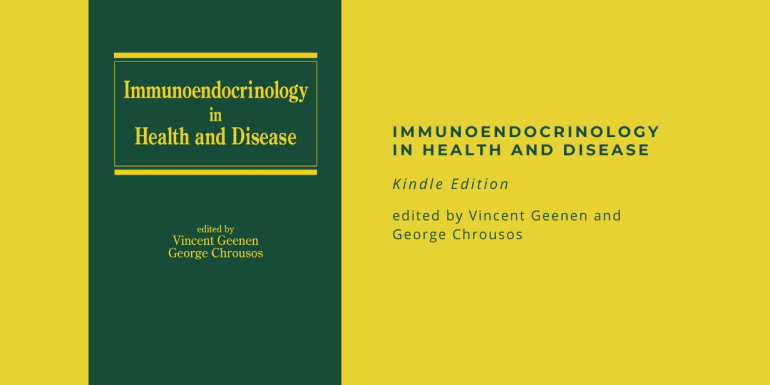
Immunoendocrinology in Health and Disease, edited by Vincent Geenen (University of Liège and FSR of Belgium) and George P. Chrousos (University of Athens School of Medicine), represents one of the great books of synthesis that contributed to structure the modern field of immunoendocrinology at the beginning of the 21st century. First published by Marcel Dekker Ltd. in 2004, then by CRC Press, it comprises nearly 800 pages and contributions from many world-renown experts.
General significance
The book appeared at a decisive moment when the traditional separation between the immune, endocrine, and nervous systems was increasingly being abandoned. Its central thesis is that these systems form an integrated regulatory network rather than independent physiological domains. The volume helped consolidate the concept that hormones, cytokines, neuropeptides, neurotransmitters, and immune mediators operate through shared signalling pathways and reciprocal feedback loops.
In this respect, the work belongs to the intellectual lineage initiated by psychoneuroimmunology in the 1970s–1990s, but it moves far beyond by proposing a more mechanistic and molecular framework. Rather than simply describing interactions between stress and immunity, the book systematically explores bidirectional communication between endocrine organs and immune cells.
Major conceptual contributions
A major contribution concerns the role of the thymus in central tolerance toward neuroendocrine self-antigens. This theme, strongly associated with the work of Vincent Geenen, anticipated later developments concerning promiscuous gene expression in thymic epithelial cells, and the importance of molecules such as AIRE and Fezf2 in self-tolerance.
The book also places strong emphasis on stress biology and glucocorticoid signalling, two areas closely linked to George Chrousos. It presents the integration of hypothalamic-pituitary-adrenal (HPA) axis function with immune regulation not simply as endocrine influence on immunity, but as a dynamic adaptive system crucial to survival and homeostasis.
Scientific architecture of the book
The first part of this book (pp. 1-415) is devoted to the fundamental aspects of the interactions between the adaptive immune system and the endocrine system. After a global view of immunological development and biology, 19 chapters extensively present the state of knowledge about the influence upon the immune response exerted by peptide hormones (growth hormone, insulin-like growth factors, prolactin and somatostatin) and steroids (glucocorticoids and sex steroids), also including neurotransmitters, neuropeptides, natriuretic peptides and vitamin D.
Two chapters detail the regulation of the hypothalamo-pituitary axis by leptin and cytokines, in particular pro-inflammatory cytokines. Programming of dendritic cell function by the peripheral nervous system, as well as the role of neuroendocrine host factors in determining susceptibility or resistance to autoimmune/inflammatory diseases are extensively described in two separate contributions.
Finally, one chapter describes the thymus as the great architect of neuroendocrine self and how a thymic defect plays a major role in priming autoimmunity against neuroendocrine glands. It also explains why the emergence of the thymus together with recombinase-dependent adaptive immunity some 450 million years ago was important to guarantee a further ‘pacific’ co-evolution between the immune and neuroendocrine systems.
The second part of the book (pp. 417-785) illustrates the clinical importance of immunoendocrinology for the understanding and treatment of the major autoimmune endocrine diseases such as type 1 diabetes, autoimmune thyroiditis, Addison’s disease, autoimmune diabetes insipidus and autoimmune polyglandular syndromes… The implication in infectious, allergic, inflammatory diseases, as well as in immunosenescence are also highlighted in 5 chapters. Recent progress in the immunotherapy of neuroendocrine tumours is also described, as well as the mechanisms of cytokine-induced sickness behaviour.
As stated in the preface of the book, “time for integrative science and medicine has arrived and is here to stay. This volume is only a first glimpse of what is coming!”
Strengths of the volume
The principal strength of the book lies in its interdisciplinary coherence. Many edited scientific volumes suffer from fragmentation, but this work maintains a relatively unified vision centred on integrated homeostatic regulation.
It is also remarkably forward-looking in several domains:
- the concept of immune-endocrine network biology,
- thymus as the architect of biological self,
- stress-system dysregulation,
- local production of neuropeptides and hormones by immune tissues,
- neuroendocrine origins of autoimmunity.
Limitations
From a contemporary perspective, some sections inevitably appear dated. The molecular tools available in 2004 preceded:
- single-cell transcriptomics,
- large-scale epigenetics,
- microbiome research,
- modern systems immunology and innate immunity,
- current checkpoint immunotherapy concepts.
Overall assessment
Scientifically, the book can be viewed as one of the landmark syntheses of early modern immunoendocrinology. It combined Chrousos’s systems-oriented stress endocrinology with Geenen’s thymus-centred conception of neuroendocrine self-tolerance. The result was an ambitious attempt to redefine immunity as part of a broader network of organismal self-regulation.
For historians of immunology, endocrinology, or systems medicine, it remains an important reference work because it captures a moment when the concept of physiological integration was becoming central to biomedical thought.
See more about the book on amazon >
Related stories you may like:
Vincent Geenen: From Thymus Oxytocin to Immune Self-Tolerance and Autoimmunity
Thymus Emergence & Evolution of Immune and Neuroendocrine Systems
The Stress Continuum of Chronic Disease Development
The Contribution of Neuroendocrine-Immune Dysfunction to Common Complex Human Diseases
The Link Between Stress, Emotions and Cytokine-Related Diseases